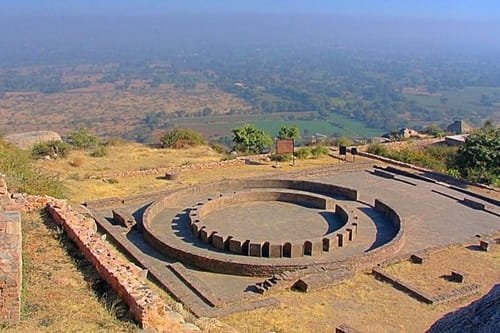
Long before Jaipur existed on any map, Viratnagar — once called Bairat — was already a capital city. According to the Mahabharata, King Virat ruled from here, and the Pandavas spent an entire year of their exile in disguise within his kingdom. Centuries later, Emperor Ashoka left his mark too, with rock edicts and one of India’s oldest surviving Buddhist structures still standing on the hill known as Bijak-ki-Pahari. Today, Viratnagar functions as a small tehsil headquarters town in Rajasthan, quietly holding onto a history most Indian towns simply don’t have. Here’s a complete breakdown of where it sits, its pin code, transport options, and what surrounds it.
Viratnagar Quick Details
| Detail | Information |
| Town | Viratnagar (also known as Bairat) |
| District | Kotputli-Behror (formerly Jaipur district) |
| State | Rajasthan |
| Pin Code | 303110 (town), 303102 (Virat Nagar post office area) |
| Historical Significance | Ancient capital of the Matsya kingdom, Mahabharata-era site |
| Distance from Jaipur | Approx. 52-82 km (varies by source and route) |
| Distance from Alwar | Approx. 61-66 km |
| Nearest Railway Station | Alwar (approx. 61 km) |
| Nearest Airport | Jaipur International Airport (approx. 77-104 km) |
| Major Roads | NH-248, Jaipur-Alwar Road |
Location and Character
Viratnagar sits roughly 80 km north of Jaipur, in what’s now Kotputli-Behror district after Rajasthan’s district reorganisation, though many older records and postal listings still reference it under Jaipur district. It’s a tehsil headquarters town, bordered by Thanagazi, Shahpura, Bansur, and Kotputli tehsils, and sits close to the Jaipur-Alwar border region. The town carries deep historical weight as the ancient capital of the Matsya Mahajanapada, one of the sixteen great kingdoms mentioned in early Buddhist texts, and later became part of the Mauryan Empire under Ashoka. Its proximity to Sariska National Park, Siliserh, and the ruins of Ajabgarh-Bhangarh has slowly turned it into a budding offbeat tourist destination for travellers seeking history alongside wildlife.
Pin Code Details
Viratnagar’s pin code shows some variation across sources. The town itself, as a tehsil headquarters, is recorded with pin code 303110 under the Rajnauta postal head office, while a separate Virat Nagar Sub Post Office in the same broader area uses pin code 303102 under the Jaipur Moffusil postal division. Given this genuine discrepancy between sources, it’s worth confirming the specific pin code with local authorities or a nearby landmark before finalising any address or delivery here, particularly since Viratnagar straddles the border of what was Jaipur district and is now part of Kotputli-Behror.
Getting Around: Roads, and Rail
Roads
Viratnagar sits directly on NH-248 (the Jaipur-Alwar Road), which handles most of the town’s connectivity to both major cities. RSRTC buses run frequently between Jaipur and Viratnagar, departing roughly every 30 minutes and taking around two hours for the journey, making it a genuinely accessible day-trip or weekend destination by public bus. Driving the same route by car typically takes just over an hour.
Rail
There’s no railway station within Viratnagar itself. Alwar Railway Station, roughly 61 km away, is generally cited as the nearest railhead, though Jaipur Railway Station, despite being further at around 100 km, offers better overall train connectivity and more frequent services, including access to the luxury Palace on Wheels train that runs between Delhi, Jaipur, Alwar, and Udaipur. Some local sources also cite Lakhakhera as a nearer, smaller station option.
What’s Nearby: Markets, Malls, and Everyday Essentials
Markets
Viratnagar’s local markets cover basic daily needs for residents and the modest but steady flow of visitors the town’s history attracts, though options remain limited compared to a full city.
Malls
There’s no organised mall infrastructure in Viratnagar, consistent with its character as a small historical tehsil town rather than a developed urban centre. Visitors typically travel to Jaipur or Alwar for larger retail needs.
Everyday Essentials
Dining options in Viratnagar are modest but present — the Ramdev Family Restaurant, offering vegan and gluten-free choices, and the Gulmohar Express vegetarian restaurant, known for Rajasthani cultural performances and terrace seating, both sit along NH-284A near the Mughal Gate. For accommodation, the Gulmohar Sariska Resort offers a stay surrounded by the Aravalli Hills, close to Sariska National Park. Historical sites within the town itself, including the Ashoka rock edicts, Bairat Temple (Chaityagriha), Bhim ki Dungri caves, and the Bijak-ki-Pahari Buddhist ruins, are the town’s primary draw for visitors rather than conventional shopping or entertainment.
Frequently Asked Questions
Q1. Is Viratnagar the same place as Bairat?
Yes, they’re the same town. Viratnagar is the modern name, while Bairat (or Bairath) is the historical name still commonly used, particularly in tourism and heritage contexts referencing the town’s Mahabharata-era and Mauryan-period significance.
Q2. How far is Viratnagar from Jaipur, and what’s the best way to get there without a car?
Distances cited range from roughly 52 to 82 km depending on the source and exact route measured. The most practical option without a car is the RSRTC bus service, which runs every 30 minutes from Jaipur and takes about two hours.
Q3. Why do different sources give different pin codes for Viratnagar?
The town uses 303110 as its official tehsil headquarters pin code, while a separate but nearby Virat Nagar post office area uses 303102. This split, combined with the recent creation of Kotputli-Behror district from parts of former Jaipur district, has led to some inconsistency across older and newer records, so confirming locally is the safest approach.
Q4. Is Viratnagar worth visiting as a day trip from Jaipur, and what should I combine it with?
Yes, it makes for a rewarding day trip given its Ashoka-era rock edicts and Buddhist ruins, and its location puts it within reach of Sariska National Park, Siliserh Lake, and the Ajabgarh-Bhangarh ruins, making it easy to combine history and wildlife in a single extended trip from Jaipur or Alwar.